This page presents some of the applications of liquid metal systems per historical applications, present endeavors, and potential future uses. These applications are for electrical energy production; the efficient and safe production of electrical energy for an expanding user base.
Applied Mechanics Engineering, through its Chief Engineer, has experience with the engineering design, analysis, and operation of large-volume liquid metal systems. This experience is from having worked on the analysis and design of liquid sodium and liquid lithium based heat transport systems for both nuclear fission and nuclear fusion reactors.
History
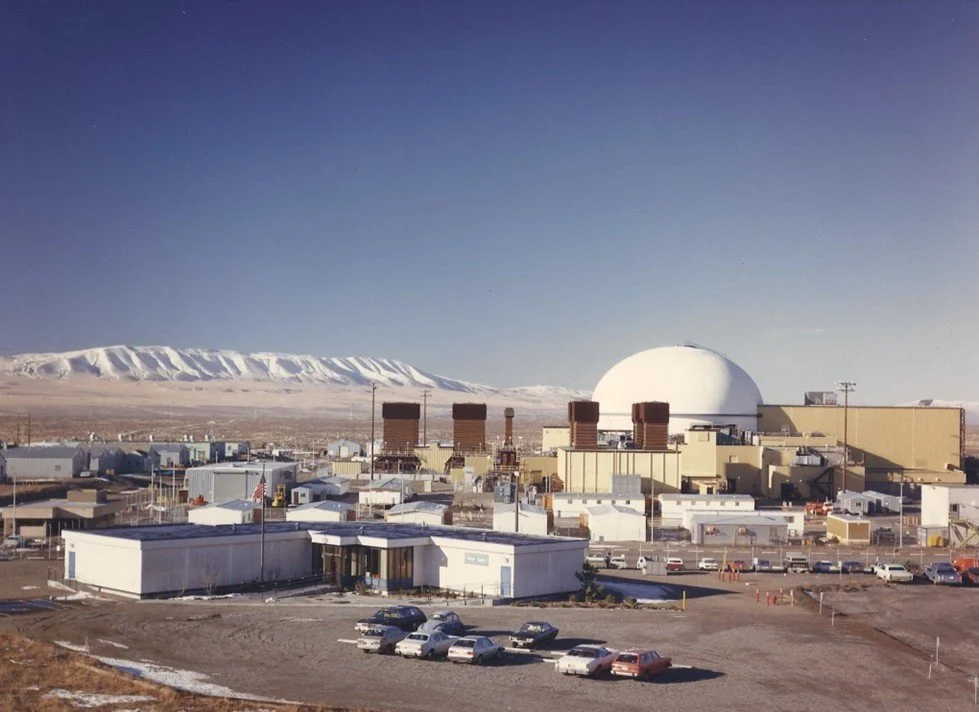
The Fast Flux Test Facility (FFTF), US DOE Facility, Operation from 1970’s into 1990’s
The FFTF was located at the US DOE Hanford Site, and served as a test bed nuclear fission reactor for materials and systems development. The FFTF reactor used large-volume liquid sodium flow circuits for both primary and secondary cooling. The reactor system included an independent and isolated liquid lithium flow loop to provide lithium cooling to some in-reactor test assemblies. The nuclear core produced neutrons in the fast portion of the spectrum of neutron energies, and the core was also designed to deliver varying neutron fluxes over the height of the core. This allowed for exposing materials to different neutron flux levels based on their vertical position in a given test assembly. The large-volume liquid sodium coolant flow through the core and the balance of plant provided an inherently safe yet still technically challenging thermal-hydraulic configuration for analyzing and certifying the reactor’s safe operating configuration.
(Image from US DOE)
history
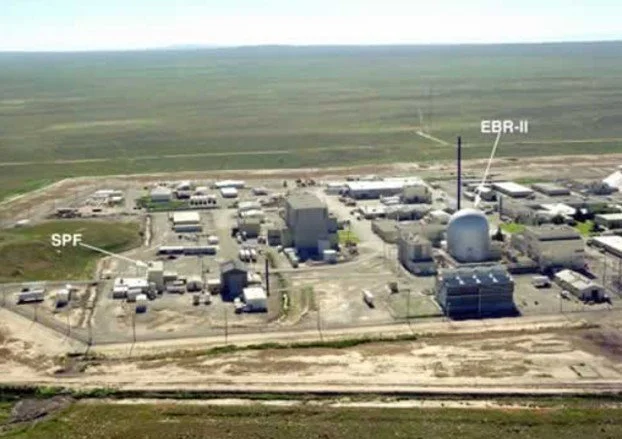
The Experimental Breeder Reactor II (EBR-II), Operation from 1960’s to 1990’s
The EBR-II fission reactor was located at the Idaho National Engineering Laboratory (INEL) as the site was designated during its operational lifetime. The reactor was cooled by a large-volume liquid sodium system. EBR-II served as a test bed for materials and systems testing, including fuel breeding and processing. The EBR-II facility also produced electric power for the local distribution grid.
(Image from US DOE)
history
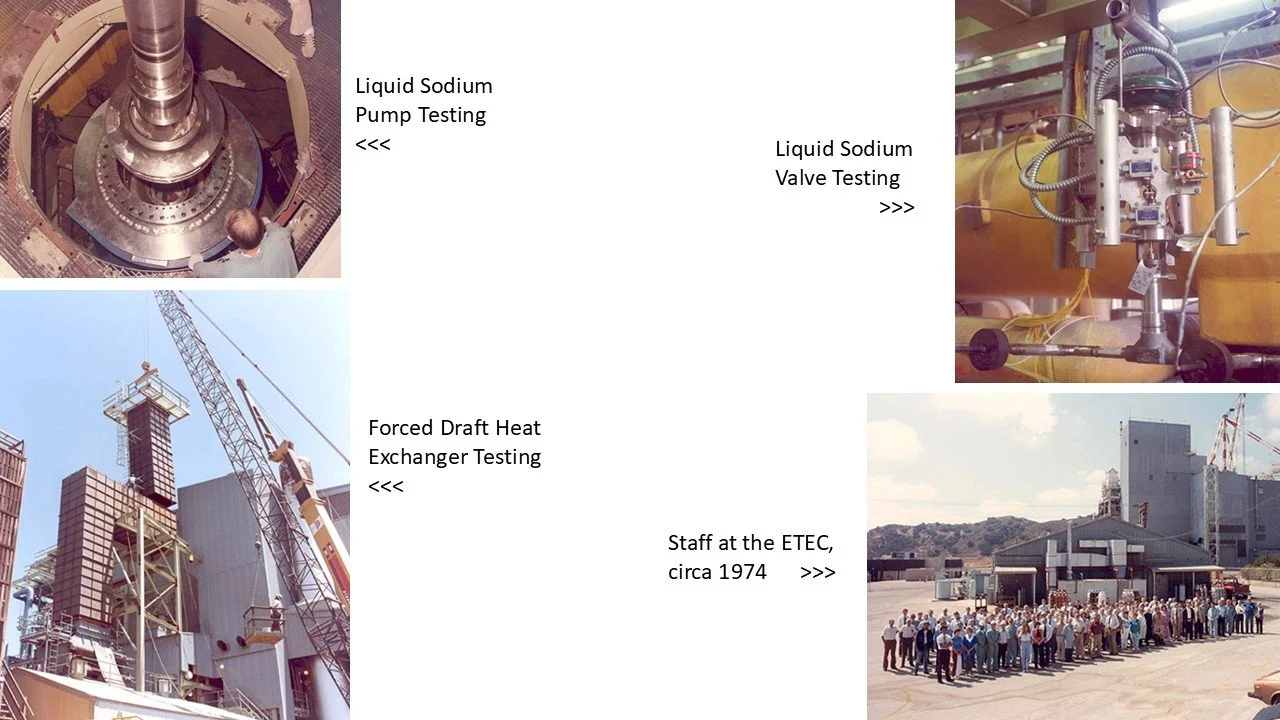
The Energy Technology Engineering Center (ETEC), Operation from 1960’s through 1980’s
The ETEC was located at the Santa Susana Field Laboratory (SSFL) in southern California and served as the test engineering center for many liquid metal components, such as heat exchangers, pumps, valves, cold traps, and other associated fluid handling equipment for large-volume liquid metal systems.
(Images from US DOE)
space reactors
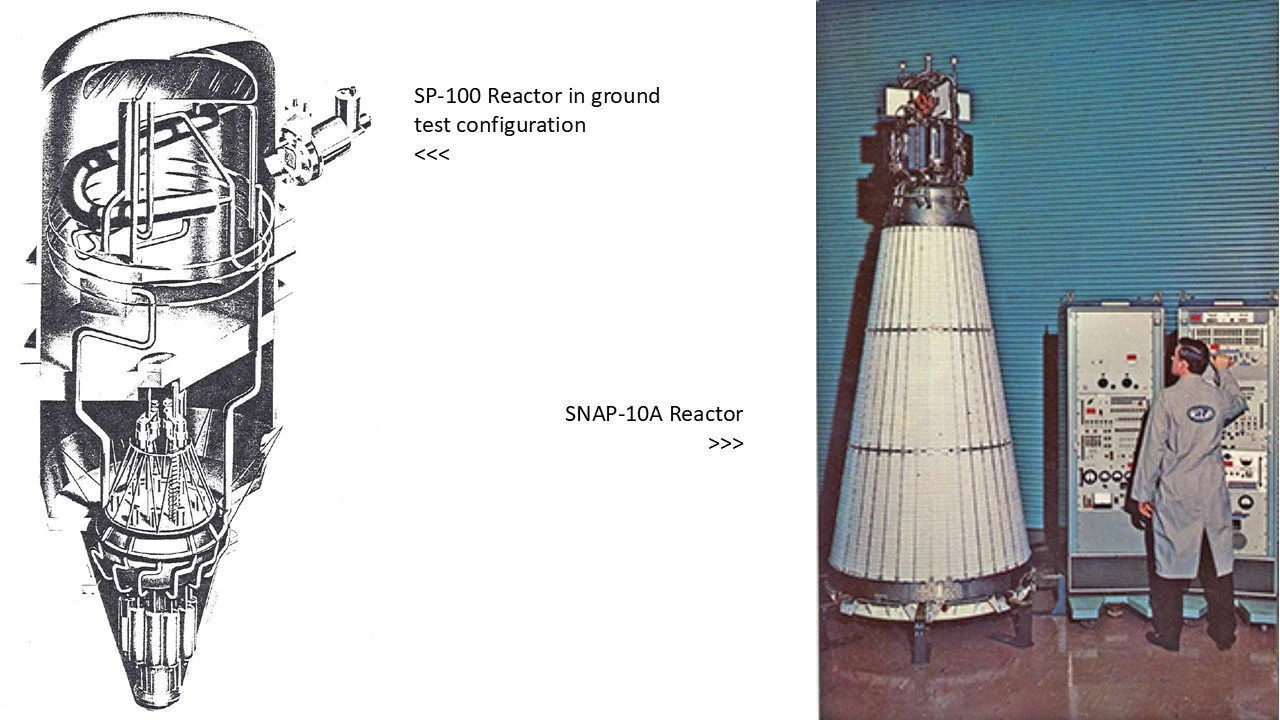
The SNAP-10A Fission Reactor & The Conceptual SP-100 Fission Reactor
The SNAP-10A nuclear fission reactor is the only U.S. reactor to fly and operate in outer space. The SNAP-10A reactor was launched on April 3, 1965, and operated in orbit for 43 days. A non-nuclear component failure shut down the reactor system prematurely, and the reactor remains in a safe condition and orbit today. The SNAP-10A nuclear fission reactor used a liquid sodium-potassium coolant (NaK), and it had an output thermal power of 45.5 kW and an output electric power of 0.65 kW.
The SP-100 nuclear fission reactor was a conceptual space reactor design that did not get matured and deployed in outer space. The SP-100 reactor was to use a liquid lithium cooling system. The ground test station for the reactor was to be located at the US DOE Hanford site using liquid lithium flow loop components not already used in the FFTF.
(Images from US DOE)
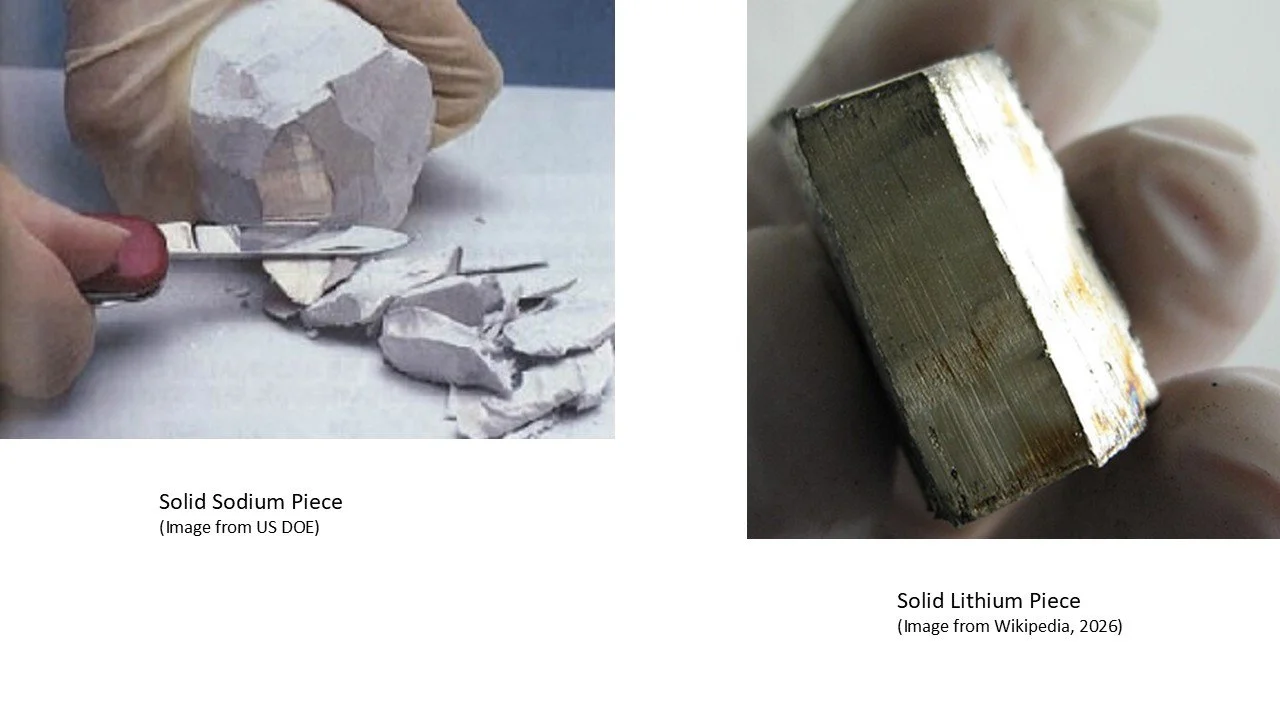
Sodium & Lithium
Sodium and Lithium as Liquid Coolants
Sodium and lithium with their very high vaporization temperatures allow for a good thermal management approach when serving as liquid coolants in high-heat flux applications. Under typical design conditions each material provides for a large safety margin between normal operation and system failure scenarios where the coolant is boiled away in certain heat transport system locations and the condition of Departure from Nucleate Boiling (DNB) is experienced. In DNB incidents metals typically fail by melting. Sodium and lithium are very reactive with water and water vapor, and can be very corrosive to certain materials. The design of a liquid sodium or liquid lithium system requires knowledgeable engineering attention to prevent adverse reactions and liquid spillage.
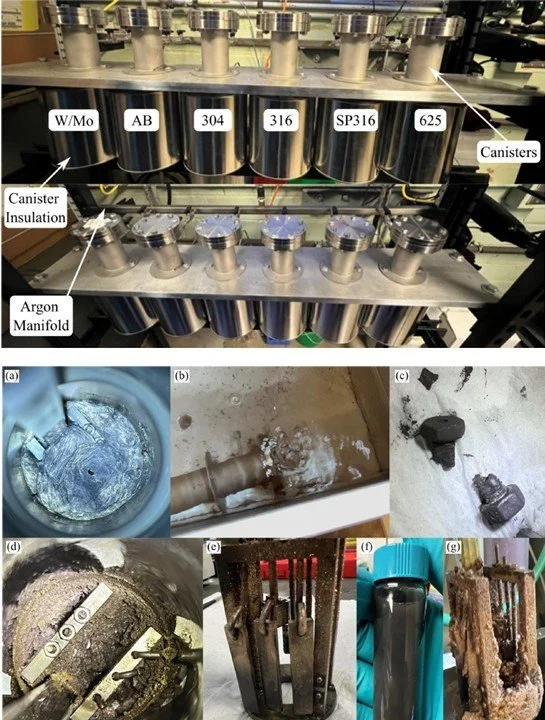
current work
Liquid Lithium Material Compatibility Testing
Liquid lithium material compatibility testing is ongoing at the University of Illinois at Urbana-Champaign. Useful materials for engineering design, such as 304 and 316 stainless steel, tungsten, and molybdenum have been found to be compatible, i.e. very low corrosion rates with static (non-flowing) liquid lithium. Reference: Ruzic, D.N., et al; Characterization of liquid lithium corrosion for fusion reactor materials; Univ. of Illinois at Urbana-Champaign; Fusion Engineering & Design 199 (2024) 114102.
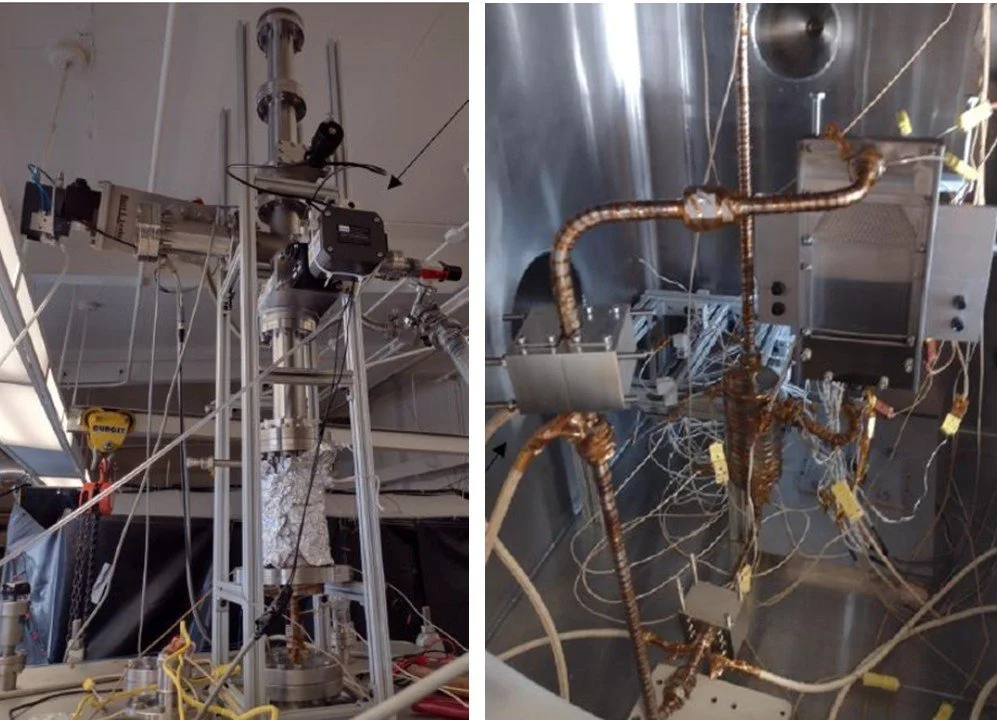
current work
Small Volume liquid Lithium Loop Testing
Small volume flow loop testing using liquid lithium has been ongoing at the University of Illinois at Urbana-Champaign. Reference: Andruczyk, D. et al; Overview of liquid metal PFC R&D at the University of Illinois Urbana-Champaign; Univ. of Illinois at Urbana-Champaign; 2024.
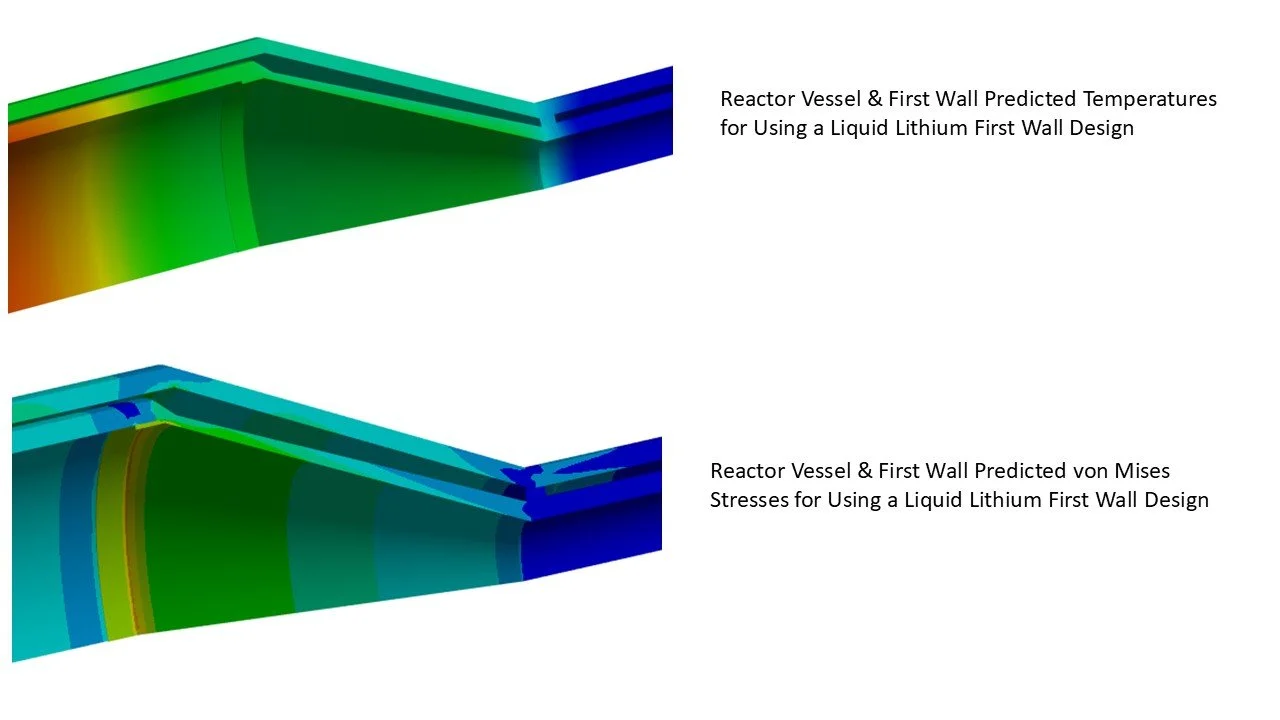
current work with near future application
The Analysis and Design of a Liquid-Metal First-Wall Structure for a Nuclear Fusion Reactor
This engineering development effort involves designing a liquid-metal first-wall structure, using liquid lithium-6, to provide thermal and radiological protection for the solid material members that comprise the balance of the first wall structure, and the confinement vessel. The liquid lithium flows through the first wall structure, is evaporated, and is replenished with a continuing flow originating from the coolant main flow channel. The bulk of the evaporated lithium is captured, condensed, and stored for future use in the reactor system.
AME is pursuing a nuclear fusion reactor design that operates with aneutronic fuels, utilizes direct energy conversion (DEC), and utilizes a liquid-metal first-wall structure in the confinement and reaction of the fusing plasma. The use in this case of a liquid-metal first-wall structure is considered vital in creating a long-life reactor design that can be both commercially competitive and adapted to harsher service environments, for instance in outer-space vehicles for nuclear electric propulsion (NEP).